Meta's social graph relies on one of the world's largest MySQL deployments. Every day, the company's data ingestion system scrapes petabytes of social graph data into the data warehouse, powering analytics, machine learning, and product decisions. Recently, Meta completely revamped this system—moving from customer-owned pipelines to a self-managed service that scales efficiently. The migration was immense, involving thousands of jobs and terabytes of data. Here are 10 key strategies and solutions that made the transition successful.
1. Understand the Scale of Your MySQL Infrastructure
Meta's social graph is powered by one of the largest MySQL deployments globally. The legacy data ingestion system incrementally scraped several petabytes of data daily. Understanding this scale is crucial because it dictates the complexity of migration: every job must maintain data integrity, latency, and resource usage. Without a clear picture of the sheer volume, teams risk underestimating migration challenges.

2. Recognize When Legacy Systems Begin to Falter
The legacy system worked well at small scale but showed instability under stricter data landing time requirements as Meta grew. Early warning signs included increased latency and resource contention. Recognizing these signals early allowed Meta to plan the migration before problems escalated, ensuring business continuity.
3. Design for Simplicity at Hyperscale
The new architecture moved away from customer-owned pipelines—which were effective at a small scale—to a simpler self-managed data warehouse service. This shift reduced operational complexity and improved efficiency. The lesson: at scale, simplicity often trumps customization because it reduces failure points and eases maintenance.
4. Define a Clear Migration Lifecycle
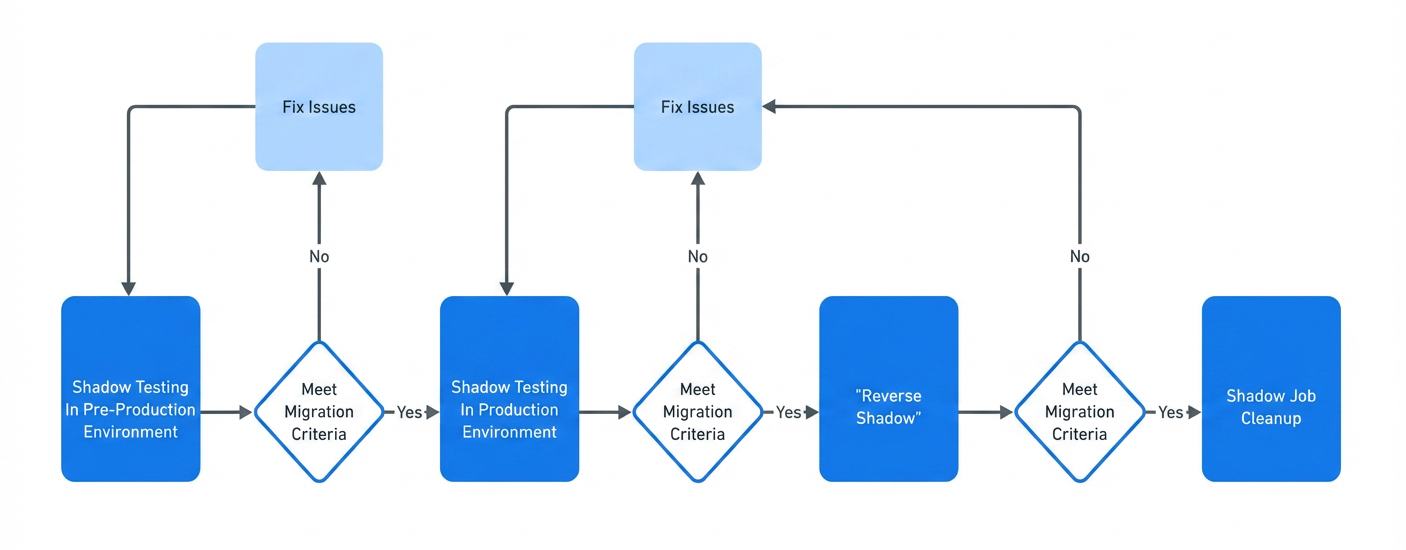
Meta established a structured migration lifecycle for each job. This lifecycle included verification stages before moving to the next step. A clear process ensured data integrity and operational reliability. Teams could track each job's status, providing visibility and control over the entire migration.
5. Verify No Data Quality Issues
Data quality was the top priority. Meta compared row counts and checksums between old and new systems to ensure complete consistency. Any discrepancy halted the migration. This rigorous verification prevented silent data corruption and maintained trust in downstream analytics.
6. Ensure No Landing Latency Regression
The new system had to deliver data at least as fast as the old one—preferably faster. Meta monitored landing latency closely during migration. If the new system introduced delays, the job was rolled back. This safeguard preserved the timeliness of data for reporting and ML training.
7. Monitor for No Resource Utilization Regression
Resource utilization—CPU, memory, I/O—was another key metric. The new system should not consume more resources than the legacy one. Meta tracked these metrics to avoid hidden costs. This ensured that the migration didn't degrade overall system performance.
8. Build Robust Rollout and Rollback Controls
Meta implemented strong mechanisms for both rolling out and rolling back changes. If any verification step failed, the system could revert quickly without affecting users. This safety net reduced risk and allowed gradual adoption, minimizing impact on downstream consumers.
9. Track the Entire Migration Lifecycle
Thousands of jobs needed coordination. Meta used a centralized lifecycle tracking system to monitor each job's progress from start to deprecation. This tracking provided real-time visibility, enabling teams to prioritize issues and manage dependencies effectively.
10. Fully Deprecate the Legacy System
Once all jobs migrated and verified, Meta deprecated the legacy system entirely. This avoided the cost and complexity of maintaining two parallel systems. The lesson: a migration isn't complete until the old system is turned off, freeing resources and reducing technical debt.
Migrating a data ingestion system at Meta's scale is no small feat. By following these 10 strategies—understanding scale, recognizing legacy limits, designing for simplicity, defining a lifecycle, verifying quality, latency, and resources, controlling rollouts, tracking progress, and fully deprecating—the team achieved a seamless transition. These lessons are applicable to any organization facing a large-scale migration, whether in data ingestion or other critical infrastructure.